
In my last post I wrote about my first job out of college working as an account manager for a packaging company. There, we insulated ourselves from pure pricing discussions by earning the trust of our customers as strategic business advisors through the practice of Key Account Management (KAM).
But let’s take this example one step further to understand the true ROI of KAM. What would have happened without a KAM approach? What if I had practiced traditional sales and simply offered good-quality, cost-competitive plastic containers within a reasonable lead time? Would we have achieved the same gains?
Now many years later, I can confidently say we would have lost business to lower-cost competitors because we couldn’t compete on price alone. It would have put us in a “race to the bottom” and accelerated the commoditization curve because the cost of entry was low and nearly anyone could make a plastic container. To win, we had to deliver differential value beyond product and service. We had to deeply understand our customers’ business and what it would take for them to win in the marketplace.
Don’t take my word for it. The Strategic Account Management Association (SAMA) has published research showing that when customers want to work in a KAM model, and you engage them effectively, the results are clear:
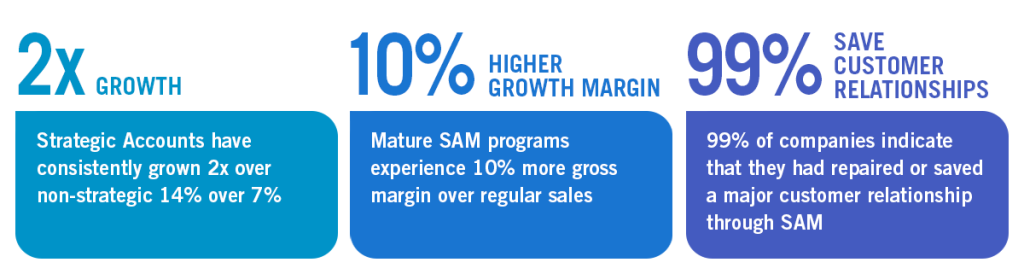
These benefits come directly from choosing KAM over a transactional approach. KAM isn’t easy, but the numbers don’t lie. You have a choice in how you engage customers. If you choose a transactional route, you must be ready to compete on price instead of value. But it takes two to tango: your customer must be willing to engage, and you must offer an effective model.

Why Are Key Accounts So Important?
If you’re still not convinced, let’s look at more financial benefits. Building and maintaining key account relationships is one of the most profitable strategies a business can invest in. Here’s why:
1. Stable, Long-Term Revenue
Key accounts often represent recurring revenue through long-term contracts or subscription models. Their loyalty helps stabilize cash flow and improve forecasting accuracy.
2. Higher Profit Margins
Even with specialized service, key accounts typically generate higher lifetime value than other customer segments.
3. Reduced Acquisition Costs
It’s far more cost‑effective to retain and expand an existing customer than to attract and close a new one.
4. Lower Retention Risks
Key accounts help reduce the risk of competitors stealing market share by building strong, sustained relationships that protect the business over time.
5. Opportunities for Upselling & Cross-Selling
Because key accounts often have broad operational needs, they create natural opportunities to expand usage or adopt additional products and services.
6. Market Influence
High-profile customers elevate your brand, open doors to new markets, and strengthen credibility with potential buyers.
7. Innovation Insights
Top-tier clients often provide valuable feedback that drives meaningful product improvements and inspires new offerings.

What Do You Get When KAM Is Done Well?
When KAM is executed effectively, the impact is unmistakable—and it shows up across both organizations. Here’s what good looks like in practice:
1. A Shared Strategy and Roadmap
Instead of random acts of selling, the relationship operates from a mutually aligned plan. You and the customer can clearly articulate:
- Their strategic priorities
- The outcomes they’re trying to achieve
- The capabilities you bring that advance those priorities
This alignment reduces friction, builds trust, and creates a sense of partnership instead of procurement.
2. Predictable, Mutual Value Creation
The most successful KAM relationships have measurable value flowing both directions. You’re not guessing what the customer values—you’ve defined it together. This mutual clarity leads to:
- Faster decision-making
- Higher ROI for the customer
- More secure retention for the supplier
When customers repeatedly see you deliver value, they become more willing to innovate, collaborate, and invest.
3. Deeper, More Productive Customer Engagement
Good KAM transforms communication from transactional touchpoints to strategic dialogues. Instead of conversations about price or order issues, discussions elevate to:
- Growth initiatives
- Innovation opportunities
- Long-term operational improvements
This shift alone is often the biggest differentiator between a vendor and a partner.
4. Cross-Functional Alignment on Both Sides
True KAM extends beyond sales. When done well, it activates:
- Marketing
- Product
- Customer success
- Operations
- Finance
Everyone understands the account’s goals and their role in delivering value. Customers feel this alignment—and reward it.
5. Stronger Negotiation Position
When you are delivering measurable value tied to customer outcomes, you are no longer defending your price. You are justifying your investment. Discussions move away from cost cutting and toward long-term returns. This makes your business far harder to displace.
6. Resilience in Market Downturns
During economic uncertainty, customers reevaluate their vendor lists. But strategic partners who deliver constant value often remain protected. KAM becomes a stabilizing force, even in turbulent markets.
7. Lower Business Risk
A strong KAM program reduces overall business risk when key stakeholders shift roles or leave the organization. By establishing multiple cross-functional connections, your partnership becomes more resilient—ensuring continuity and stability that isn’t dependent on any single individual.
Put It To Work
To test your organization’s appetite for the outcomes of Key Account Management, ask yourself the following questions:
- Are you struggling to compete on price?
- Do you have difficulty repairing or saving damaged customer relationships?
- Can you envision ways to create differential customer value beyond product and service?
If you’re comfortable with your business as it is, KAM may not be for you. But if you’re struggling with growth, retention, or prioritization, KAM may be exactly the structure and discipline your strategic selling process needs.


Conclusion
KAM is not a box to check. It’s not a quarterly meeting or a slide deck. It’s an organizational capability, a mindset, and a discipline. When done well, it creates mutual growth, innovation, loyalty, and financial strength for both parties. When done poorly—or ignored—it leads to commoditization, lost opportunities, and declining customer relationships. The question is whether you’re ready to commit to the discipline required to unlock its value.