
In today’s hyper competitive markets, businesses don’t grow by chasing every lead—they grow by nurturing the right relationships. And among all the customers a company serves, a select few stand out for their strategic value, long term potential, and outsized contribution to mutual growth. These high value clients are known as key accounts.
But what exactly is a key account? How are they different from regular customers? And how can a business identify which customers deserve this level of attention?
This guide will help you answer those questions and begin the customer segmentation process, which is foundational to a successful key account management (KAM) journey.
Defining a Key Account
A key account is a customer that holds exceptional strategic importance for a business. This importance typically comes from a combination of factors, including:
- High revenue and profitability contribution
- Long-term growth potential
- Strong influence in the market
- Opportunity for expanded business
- Strategic alignment between the two organizations
In simple terms, a key account is not just any customer. It is a client considered vital to the company’s financial stability, growth, and competitive advantage.
Key accounts often receive:
- A dedicated account manager and cross-functional account team
- Customized service, pricing, and/or product solutions
- Mutual value co-creation initiatives
- Long-term strategic planning
- Executive level relationship involvement
One critical mistake we see our clients making is skipping customer segmentation altogether and lumping all their customers – or at least their large customers – into key accounts. Not only does this make scaling incredibly difficult, but it’s also not realistic to spread your limited cross-functional support resources across so many customers. So, you’re basically diluting the overall impact of your KAM program from the get-go.
I’ll always remember the wise words of my marketing professor, “Sacrifice is the essence of positioning.” Said another way; by avoiding a tough decision, you’re actually making a tough decision – and ultimately setting up your KAM program to fail. Less is definitely more, especially when just starting out or proving the concept.

How Key Accounts Differ from Other Accounts
All customers are important, but not all customers require the same level of attention. Understanding the differences between “core” accounts and “key” accounts helps clarify why certain clients deserve a disproportionate amount of resources to support them.
(Please note I’m using “core” as a general term to describe the portion of your business that is anything other than “key.” What’s more, “key” accounts are also referred to as “enterprise”, “growth” or “strategic accounts.” And sometimes those terms represent a further level of segmentation, which we will address in another blog post. For now, realize whatever you choose to call them isn’t as important as the clear criteria you use to identify them.)
1. Value to the Business
- Core accounts: Generate predictable but moderate revenue, often with slower rates of growth.
- Key accounts: Contribute disproportionately to total revenue—often 20% of customers producing 80% of revenue (Pareto principle).
2. Relationship Complexity
- Core accounts: Transactional, straightforward interactions. Typically only 1-2 key stakeholders make all business decisions.
- Key accounts: Multi layered team, involving executive stakeholders, cross department collaboration, and deep integration.
3. Customization Level
- Core accounts: Content with standardized offerings and not interested in pursuing new or innovative solutions.
- Key accounts: Open to collaboration and interested in exploring and building better solutions together.
4. Strategic Importance
- Core accounts: Important but not essential to the future of your business. Ideally replaceable by your emerging key account pipeline.
- Key accounts: Critical for long-term growth, market expansion, brand credibility, or innovation.

How to Identify Key Accounts
The process of identifying key accounts is both objective and subjective, and it’s a two-way street. Just because you may view a customer as strategic doesn’t mean they view you as strategic. In order to create mutual value, both parties must be on board. Because of this, we suggest using two (2) dimensions to identify your key accounts: strategic importance and ability to win.
To help set clear selection criteria, companies often use a combination of quantitative and qualitative criteria, such as:
Strategic Importance – How important is the customer to us?
- Revenue & Profitability – Consider deal size, purchase frequency, profit margins, and lifetime value. Would losing the account have significant impact on your business?
- Growth Potential – Is the customer in a growing market? Are they positioned to gain share or grow the pie? Does this align with our product roadmap or growth aspirations?
- Relationship health – Are we connected with key decision makers? Is the customer willing to collaborate and grow together?
Ability to Win – How important are we to the customer?
- Strategic Fit – Do we align with the customer’s goals and objectives? Can we offer differential value that allows them to win in the marketplace?
- Relationship health – Is the customer engaging with us on a regular basis on a strategic level? Are we considered a trusted business advisor or just a preferred supplier?
- Value portfolio – Do we have a track record of creating mutual value together and do we have a healthy pipeline of ideas for the future? Can we place an estimated customer value on these joint initiatives? What’s in it for the customer, not us.
Finding the true fit
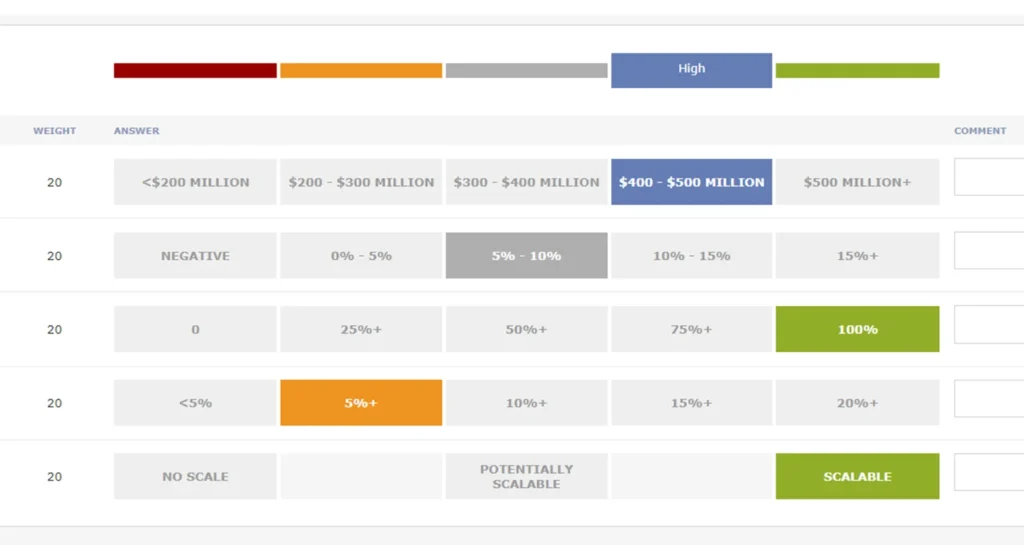
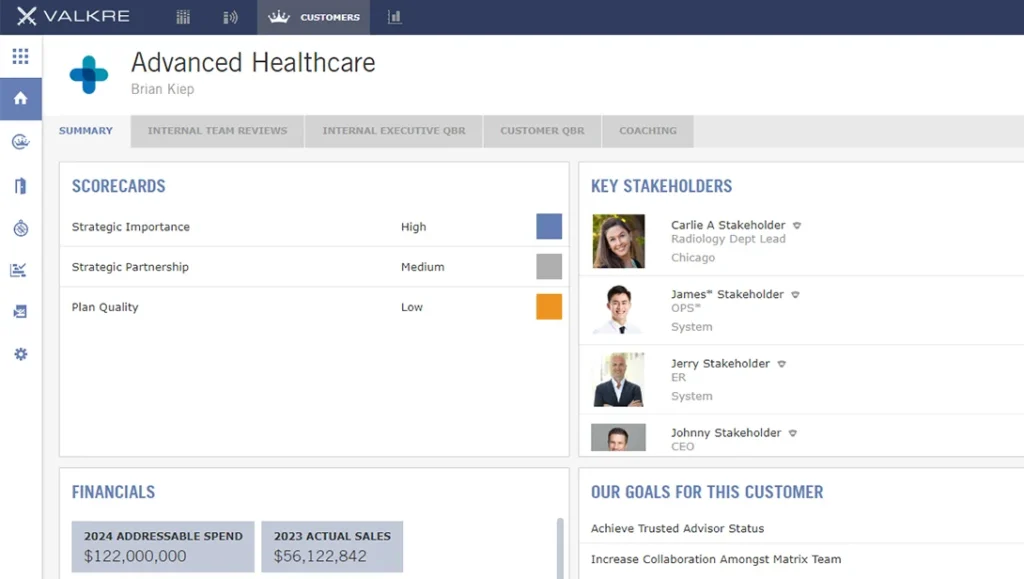
Once you’ve determined your key account selection criteria, you can enable cross-functional account teams to rate them on a weighted scale using an interactive tool such as Valkre’s FIT Scorecard, shown below. Once complete, you can then compare the scores across your portfolio of customers to check the credibility of your criteria and adjust resourcing and priority decisions accordingly. This is a great way to bring data and structure to an otherwise subjective – or even political – evaluation.
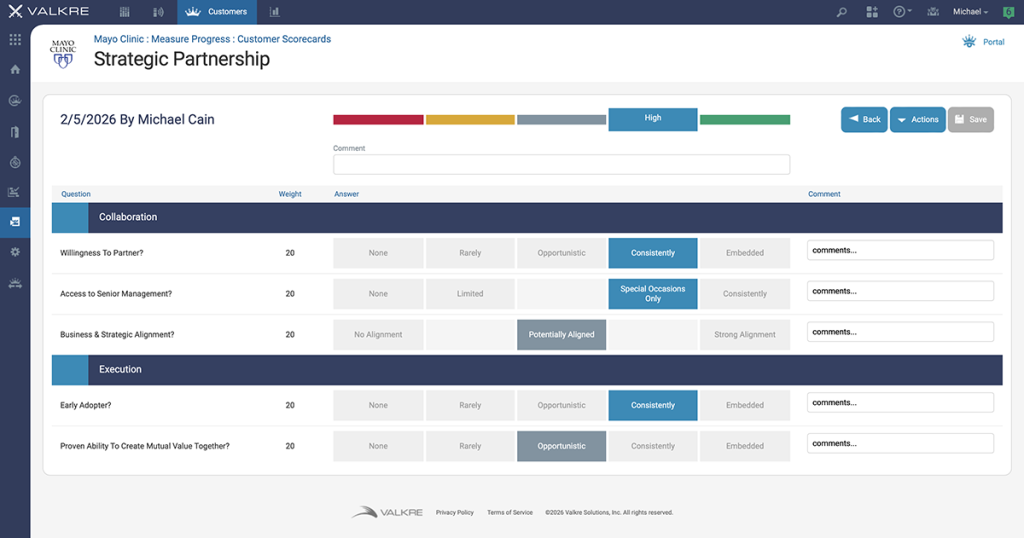
Interactive tools like Valkre’s FIT scorecard can help cross-functional teams bring a quantitative lens when selecting key accounts.
Partner Perspectives
In this section, we link to content from our partners in the strategic account management community. Please note some of the content may require paid membership.
LEARN MORE
For a deeper dive on how to select key accounts, check out this webinar from the Strategic Account Management Association (SAMA).
Selecting the Right Strategic Customers- A Key Driver of Performance
Examples of Key Accounts
Key accounts vary by industry, but common examples include:
- A software company’s fastest-growing enterprise customers
- A manufacturer’s national retail partners
- A consulting firm’s multi-year corporate clients
- A logistics company’s high-volume transportation partners
- A marketing agency’s long-term brand retainers
As we’ve covered, the defining factor is not size alone—but strategic significance and ability to win together.
Put It to Work
To test your organization’s readiness and ability to identify key accounts, ask yourself the following questions:
- Which customers represent the most revenue and profitability for your business? (Use the 80/20 rule)
- Which customers are ready to engage with you in a more strategic fashion beyond transactional needs?
- Which customers are willing to reward you for differential value beyond your core product or service offering?
This will get you started on the customer segmentation process. From there, you can start to define specific selection criteria in terms of strategic importance and ability to win, use a weighted scorecard to review your entire customer portfolio, and practice discipline to determine who your true key accounts are.
You should also review your customer portfolio regularly – we recommend twice per year – to reflect changing market or business conditions.

Conclusion
A key account is more than a customer—it is a strategic partner. By understanding what makes these clients unique and investing in strong Key Account Management practices, businesses can unlock incremental revenue, create exceptional customer experiences, and gain a competitive edge.
Whether you’re scaling a startup or optimizing a mature organization, identifying and nurturing your key accounts could be the most important growth strategy you implement.