

After graduating college many moons ago, I packed up my life in Northwest Ohio and headed for the West Coast to start a role as an account manager for a Fortune 500 packaging company. At the time, I’ll admit I didn’t fully understand what an account manager actually did or how it differed from a traditional sales role. In my mind, I pictured “wining and dining” customers and spending afternoons on the golf course. Truthfully, I was more focused on living in a vibrant city surrounded by other young, ambitious people. (Don’t judge; I was only 21!)
But once I began calling on a major CPG (consumer packaged goods) company—and thanks to the guidance of a fantastic boss and mentor—I quickly realized just how different account management is from the stereotypical sales image I’d imagined. (Spoiler alert: I didn’t even pick up a set of golf clubs until much later in life.)
In my account management role, I regularly met with the customer’s research & development teams, product managers, and business leaders to understand not just their immediate needs, but their broader goals and long term vision. At the most basic level, yes, I represented their preferred packaging supplier. Their fundamental need was a single use container to transport household cleaning products to retailers and eventually to consumers. But we never started there.

Instead, we talked strategy.
We explored their commercial goals for the year and how they planned to outpace competitors.
We reviewed the latest consumer trends and research.
We then collaborated to translate those insights into innovative packaging concepts that could win on the shelf.
I knew their procurement team, of course, and they were aware of my work—but procurement wasn’t the focal point of our relationship. By engaging early in the design process and working shoulder-to-shoulder with cross-functional teams, my company earned a level of trust that protected us from being reduced to a simple pricing comparison.
In other words, I had become a strategic partner — a trusted business advisor embedded in their ecosystem. And because of that, a lower cost competitor couldn’t displace what we had built together, even with a steep discount. What’s more, the customer continued to return to us for countless product design projects across multiple business units, not because we offered the cheapest plastic container, but because we provided meaningful value: business insight, technical expertise, and speed-to-market advantages, all wrapped in a relationship that made their jobs easier and their products more successful.
Years later, now working for a company that helps organizations implement Key Account Management (KAM) practices, I’m still amazed by how many companies struggle to understand what KAM really is—and how fundamentally different it is from transactional selling. Don’t get me wrong: there is absolutely a business case for both approaches, sometimes even within the same company. But the long-term, strategic benefits of true Key Account Management are well documented and exceptionally powerful.
So, let’s start with the basics and build from there.
What Is Key Account Management (KAM)?
Key Account Management (KAM) is a strategic approach to managing and nurturing an organization’s most valuable customers — those who contribute significantly to revenue, profitability, and long-term growth. Unlike traditional sales, which often focuses on short-term transactions and lead generation, KAM emphasizes building deep, collaborative relationships with a select group of high-value accounts.
KAM is the structured, strategic process of managing and growing relationships with an organization’s most important clients.
A typical KAM program includes:
- Dedicated account managers and support teams
- Multi-year account planning
- Executive sponsorship
- Tailored products and/or service packages
- Regular business reviews
- Deep cross-functional collaboration (sales, product, support, leadership)
Simply put, KAM is not a sales tactic—it is a long‑term business strategy.
The Inverse Sales Funnel Concept
If it’s still not clicking, picture two funnels. In traditional sales, the funnel starts wide at the top, representing a broad universe of potential customers, and narrows as prospects move toward awareness, consideration, and ultimately purchase. In KAM, the funnel is inverted: you start narrow at the top with a few key accounts and widen as engagement deepens over time, expanding opportunities within those accounts.
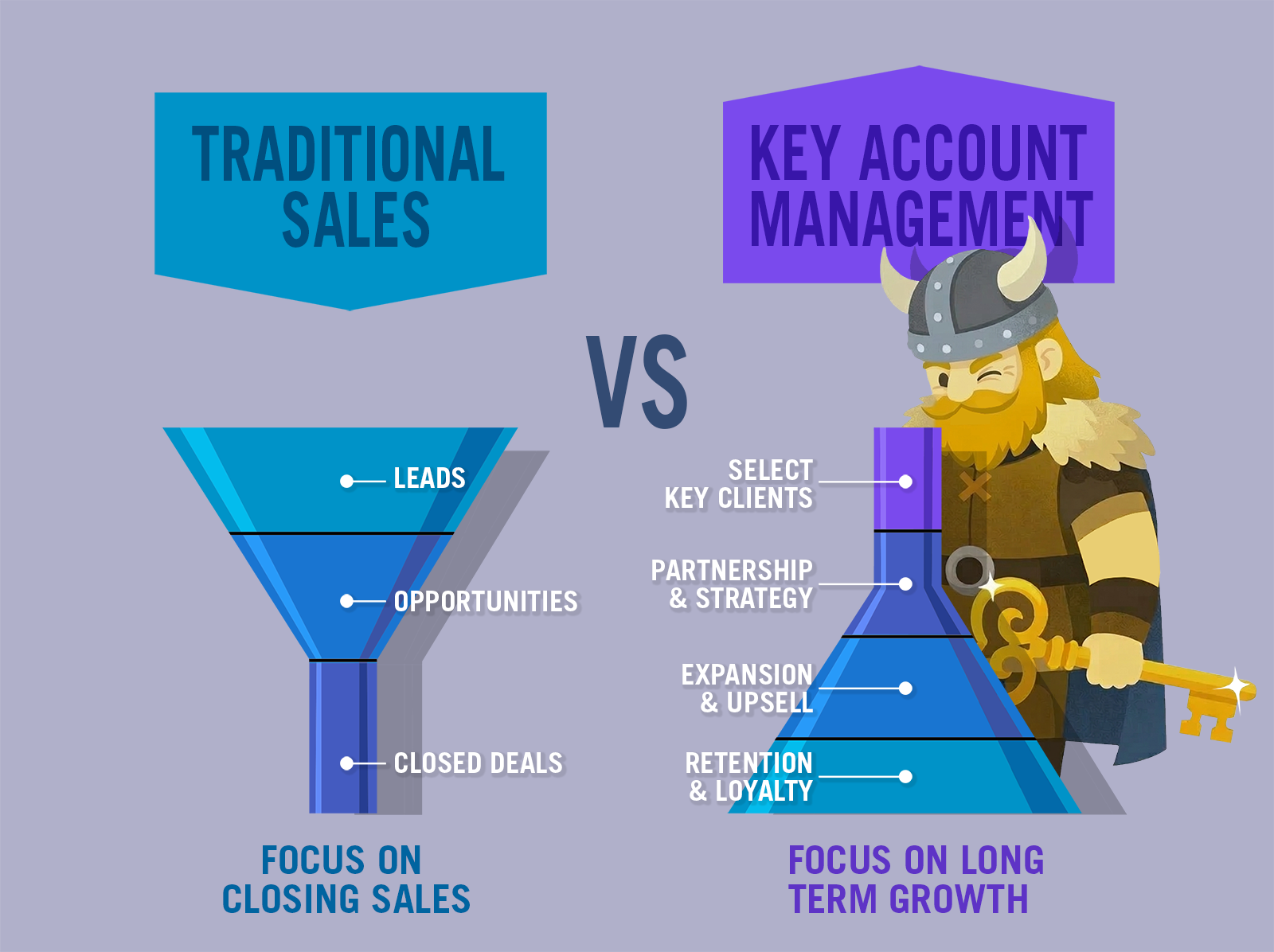
Key Account Management is essentially the inverse of a traditional sales funnel, starting narrow at the top with a few key accounts and widening as relationships grow and opportunities multiply.
How KAM Differs from Traditional Sales
To be clear, one approach is not better than the other. It all depends on your strategic imperatives and go-to-market approach. Perhaps some direct comparisons will help.
| Traditional Sales | Key Account Management |
| One‑off transactions | Long‑term strategic partnerships |
| Focus on closing deals | Focus on creating shared value |
| Broad customer base | Select group of high‑value clients |
| Short sales cycles | Long, evolving relationship cycles |
| Product-focused | Solution- and outcome-focused |
| Limited internal collaboration | Cross-functional, strategic collaboration |
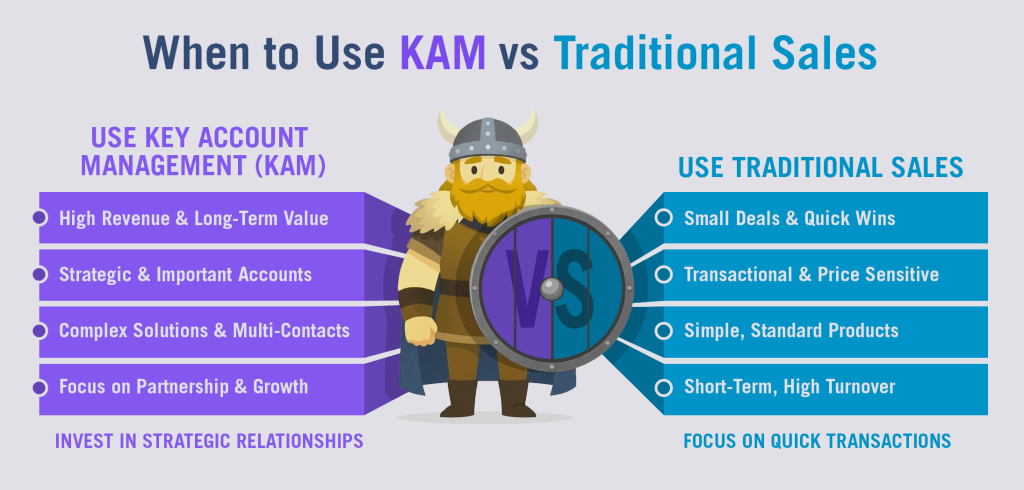
When to use KAM vs. Traditional Sales
Both approaches have their time and place. KAM is the right approach when some customers have disproportionately large impact on revenue, growth, stability, or strategic direction.
Below are the key conditions:
1. When a customer represents high revenue or long-term value
Use KAM when the account can significantly influence your business through:
- Recurring revenue
- Multi‑year contracts
- Large volume purchases
- Cross‑sell and upsell potential
Why? Traditional sales optimize for short-term deals; KAM optimizes for lifetime value.
2. When the account is strategically important
ChooseKAM if the customer is important because of:
- Brand prestige / market influence
- Entry into new markets or industries
- Co‑innovation, R&D collaboration
- Competitive advantage
Why? These accounts provide value beyond revenue.
3. When the customer’s needs are complex
UseKAM when the solution requires:
- Multiple internal teams (IT, operations, finance, product)
- Customization or integration
- High-touch service and support
- Executive alignment
Why? Traditional sales can’t easily manage this complexity.
4. When success requires multi‑stakeholder engagement
Use KAM if both sides have:
- Many departments involved
- Multiple influencers or decision makers
- Lots of interdependent work streams
Why? Traditional sales typically only has one point of contact, which risks misalignment. KAM is necessary to coordinate everything.
5. When losing the customer would be high risk
Use KAM when losing the account would mean:
- A major revenue hit
- Market share loss
- Loss of credibility
- Operational disruption
Why? KAM focuses on retention, continuity, and long-term stability.
6. When partnership is more valuable than a transaction
Choose KAM if you aim to:
- Co-create value
- Share insights and roadmaps
- Collaborate on innovation
- Become a strategic supplier
Why? This requires trust, depth, and ongoing relationship building—not just deal closing.
When NOT to Use Key Account Management
KAM sounds wonderful, but it’s not a silver bullet for every business situation. It’s important to distinguish when KAM makes sense as it relates to the strategic imperatives for your company. Below are some basic guidelines for when to employ KAM versus traditional sales.
Avoid practicing KAM when your customers are:
- Small, low-revenue, or low-margin
- Highly transactional
- Price-sensitive with no loyalty potential
- Not interested in deeper partnership
- Too costly to support at KAM level
Traditional sales is the better fit here.
It’s important to also note that Key Account Management takes time. You won’t see an immediate lift in sales like you might after an advertising campaign or trade show. Research shows it takes about 12 to 18 months for customers to respond to a more strategic approach and start to reward you for it. So if you go the KAM route, you must be patient, which is difficult in today’s rapidly changing environment.
In summary, use Key Account Management when a customer’s importance justifies investing cross-functional resources to build a long-term, strategic partnership. Use traditional sales when the relationship is primarily transactional and short-term.
Partner Perspectives
In this section, we link to content from our partners in the strategic account management community. Please note some of the content may require paid membership.
LEARN MORE
For a deeper dive on defining Key Account Management, check out this article from our friend Adrian Davis at Whetstone:
Moving Beyond Transactional Selling
Challenges and Considerations
Be warned, KAM is not for everybody. It requires a significant cultural shift from transactional to strategic thinking. It demands investment in talent, tools, and processes. And success depends on executive sponsorship and cross-functional collaboration. Like so many things in life, if it was easy, everybody would be doing it – including your competition.
Put It To Work
To test your organization’s readiness to practice Key Account Management, ask yourself the following questions:
- What are your company’s strategic imperatives? What role would KAM play in the execution of the strategy?
- Do your customers typically engage on a long-term strategic level or is it largely short-term and transactional?
- Is your organization ready to invest in the talent, tools, and processes required for a successful KAM program?
Conclusion
Key Account Management is not just a sales strategy—it’s a business model focused on creating long-term value for both the company and its most important customers. It’s not easy and it takes time to see the fruits of your labors. However, rest assured, by inverting the traditional sales funnel and prioritizing depth over breadth, organizations can unlock growth opportunities that go far beyond individual transactions.