

Every organization has a few rock stars, the ones who read a room instinctively and somehow bridge the gap between “vision” and “execution” on their own. As Thomas Edison put it, “Vision without execution is hallucination,” and your top performers seem to have solved for both.
The problem is rock stars are rare. The rest of your team trains on the same methodology, sits through the same workshops, and still retreats to old habits once they’re back in the field. Average isn’t just a performance issue. It dilutes results, demotivates your best people, and, in an AI-enabled world, makes the case for automating the role entirely.
At the 2026 SAMA Annual Conference, I had the chance to unpack this problem alongside three experts who see it from different vantage points: Adrian Davis, President of Whetstone, Brad Weintraub, SVP of Global Strategic Accounts Program at AVI-SPL, and Phil Styrlund, CEO of The Summit Group. Our session, “The End of Average: Multiplying Top-Performer Results at Scale,” argued that moving the middle isn’t a training problem. It’s a system design problem. Here’s what we covered.
The Misdiagnosis
Adrian Davis opened with the uncomfortable truth: most organizations are solving the wrong problem in three specific ways.
- Wrong unit. We treat the middle as individuals to be fixed. We pull them out, train them, and drop them back into the exact same environment, which never changed.
- Wrong measurement. We mistake activity for impact. Dashboards look green because people are checking boxes, but engagement isn’t the same thing as compliance. The dashboard lies.
- Wrong environment. We return people to the same pull. Managers reward the old behavior, peers expect it, and incentives reinforce it. The system wins every time.
The Reframe: You Are Not the Hero
If the diagnosis is wrong, the fix has to start somewhere else. Adrian’s reframe was simple but sharp: you are not the hero of the account. Your customer is. That means walking into a meeting with their challenge front and center, not your capability deck.
On its own, that’s a slogan. The middle of your team will nod along and go right back to pitching, because nobody gave them a concrete alternative. The reframe needs a method, and Adrian offered a straightforward one called Third Box Thinking™. Don’t begin with what you sell. Begin with your customer’s customer.
Picture three boxes: you, the supplier; your customer, the buyer; and the end customer, the one your customer is ultimately trying to serve. Understand what that end customer is trying to achieve, then identify where your customer’s own value proposition falls short in meeting that need. Only then does it make sense to bring your own capabilities into the conversation.
The System Answer: Change the Pod, Not the Person
Here’s the diagnostic Adrian challenged the room to run: count how many people get trained per account. If the answer is one, you’re not driving behavior change. You’re doing professional development for an individual who will return to an unchanged team.
The minimum viable fix is training the account manager and their manager together. The gold standard is training the full cross-functional pod that touches the account, so the new behavior has support structure around it instead of resistance.
Brad Weintraub brought this to life with AVI-SPL’s own experience. AVI-SPL didn’t just train individuals. They built the environment that made the new behavior the path of least resistance, which is the real marker of whether a change will stick.

SAM as a Management System, Not a Sales Strategy
Brad then shifted the lens from the individual account team to the enterprise. His argument: a Strategic Account Management program isn’t a sales strategy off to the side. It operationalizes company strategy inside your most important customer relationships, which means treating it as a management system, not a methodology, that sits between company strategy and client strategy and translates both into a shared value agenda. That only works with real governance:
- Executive steering sets priorities, resolves resource conflicts, and sponsors strategic relationships.
- A SAM leadership council owns methodology, account selection, and cross-functional governance.
- Strategic account teams build plans, orchestrate internal capabilities, and engage client stakeholders.
- Client value delivery executes commitments, measures outcomes, and feeds insight back to the enterprise.
Without governance, SAM becomes influence without leverage. With it, SAM becomes an actual growth engine.
Where Strategy Meets Software
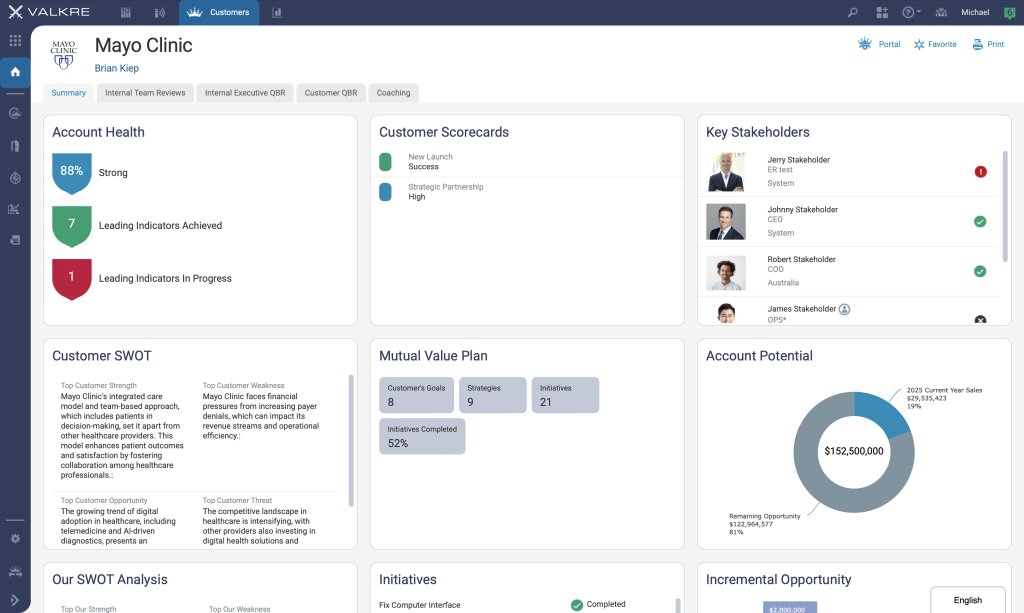
I closed the session by looking ahead to where KAM enablement is headed, and the honest answer is that most organizations fall into one of two traps. They either lead with technology or they improvise with spreadsheets. Both feel like progress. Neither actually moves the needle.
- Trap #1 — buying a tool before you’ve defined how you work. It’s like buying a suit before you know your size. The tool becomes the strategy by default, and your team ends up serving the software instead of the other way around, which shows up as forced workflows, low adoption, and frustration.
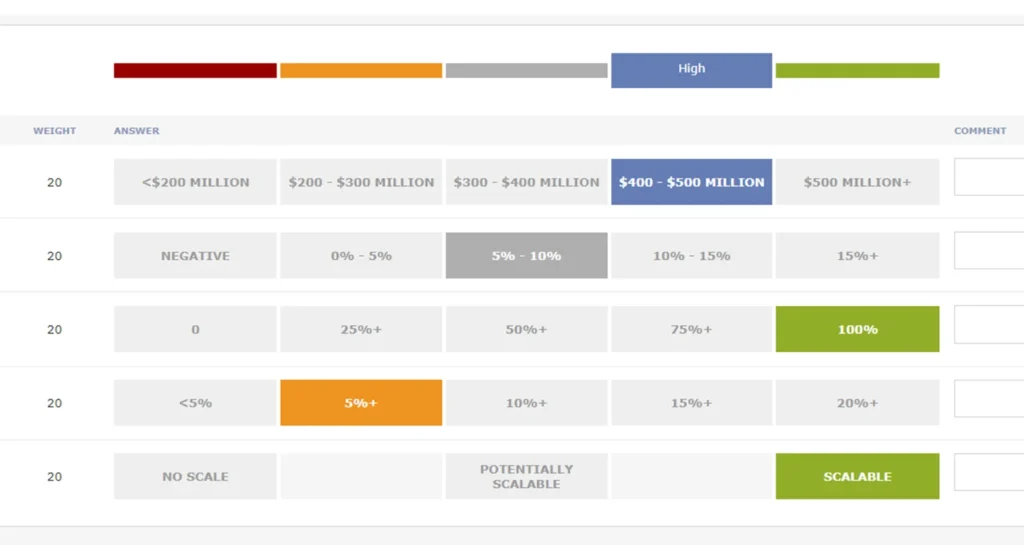
- Trap #2 — building a strong framework and then relying on ad-hoc tools, usually spreadsheets and offline trackers, to run it. That works fine for one person for one quarter, but homegrown templates can’t scale or surface patterns, and they make coaching nearly impossible. You’re flying blind toward inconsistent execution and limited visibility.
The real question isn’t which tool to buy or which template to build. It’s what your approach actually requires and what infrastructure will genuinely support it. Strategy execution needs both a deliberate method and the infrastructure to carry it. When those two are misaligned, you get friction no matter how good either one is in isolation.
Practical recommendations
If you buy into the idea that moving the middle requires combining thoughtware and software, the real question becomes how you avoid both traps and put them into practice at the same time. The good news is there’s a practical roadmap for any organization serious about building that capability and improving the business outcomes it drives:
- Start with your existing methodology rather than replacing it wholesale.
- Digitize governance, not just documents.
- Track leading indicators alongside final outcomes.
- Invest in training and technology enablement together, not one instead of the other.
- Treat your KAM program as a strategic asset, not a sales support function.
Implementation Roadmap
This isn’t a software rollout. It’s a capability transformation, and the roadmap should reflect that. A realistic version runs in three phases.
- First 90 days — establish the operating system. Before anything scales, the foundation has to be right: align on the methodology, configure the software to reflect your actual strategic approach, and get early adopters working in the system, not around it.
- 90 to 180 days — scale what’s working. Once the model is proven with a core group, you expand deliberately. This is where coaching becomes data-driven. You can see where teams are strong, where they’re stuck, and what good looks like, so replication gets faster because the system carries the process.
- 6-12 months — institutionalize KAM excellence. By the end of year one, this shouldn’t feel like a change initiative anymore. It should feel like how you work, with reviews, planning cycles, and performance conversations all running through the same operating system. The methodology is embedded, not enforced.
Most transformations fail because they stop at deployment. A roadmap built this way is designed to get past adoption and into institutionalization, where the behavior change outlasts the initiative.
Phil’s One Thing: Who You Are Matters as Much as What You Do
As moderator, Phil Styrlund closed the session by asking each of us for one thing the audience could take away to move the middle. His own answer reframed the whole conversation one more time.
Most SAM programs build skills and competencies. That’s what you do, and it’s horizontal development: building breadth. What most programs miss is character, mindset, and cognitive depth. That’s who you are, and it’s vertical development: building depth. Phil’s point was that you can hand someone every framework in this post and still get average results if you haven’t also developed the person underneath the role.
The Takeaway
The organizations that lead the next era of KAM will be the ones that embed strategy into daily execution through an integrated, insight-rich operating system, not the ones with the most talented individual account managers. The transformation is already underway. The real question for leaders isn’t whether KAM methodology and technology should converge. It’s how quickly they can make it happen and stay competitive.