

A beginner-level KAM program proves the model works. An intermediate one proves it scales. This post picks up where Level 1 left off — for teams who have spent at least six months running the starter framework and are ready to add depth.
In our first post in this series, we covered where to start in building a KAM program from scratch. In Level 1, we operationalized that foundation with a starter set of tools mapped to a basic workflow. Now we go further — adding the frameworks that separate a program that simply runs from one that performs with even greater impact.
Know When You’re Ready
Readiness for Level 2 isn’t a date on the calendar. It’s a pattern you can observe in how the team is already working.
- The beginner toolkit has become a habit, not a chore — profiles, stakeholder maps, and account plans are current without prompting.
- Dashboards and reports are being used to make decisions, not just to satisfy a reporting requirement.
- The team has started asking sharper questions than the beginner tools can answer — “Does this customer really value being a strategic partner with us?” or “Does our team have the capabilities to meet this customer’s needs?”
If that sounds familiar, you’re not behind. You’re exactly on schedule.
Two Disciplines Emerge: Analysis and Planning
At the beginner level, understanding your customer and planning your response tend to blur into a single motion — you learn something, then you act on it. As a program matures, those become two distinct disciplines. Analysis is about getting an honest, structured read on where things stand, on both sides of the relationship. Planning is about deciding, deliberately, what to do about it. Splitting them apart is one of the clearest signals of a maturing program.
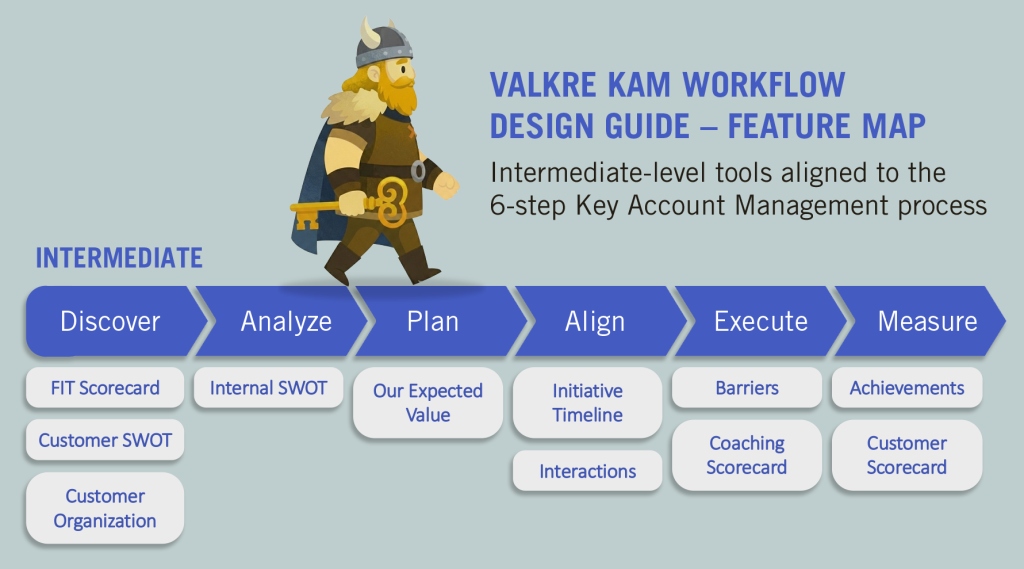
Tools Aligned with the Next Level of Maturity
The tools below build directly on the beginner starter package. None of them replace what you’re already doing — they add resolution to it.
1. Discover
Beginner-level discovery tells you who the stakeholders are and what they care about. Intermediate discovery tells you how healthy the relationship actually is, how the customer sees itself, and how the account is physically and organizationally structured.
FIT Scorecard
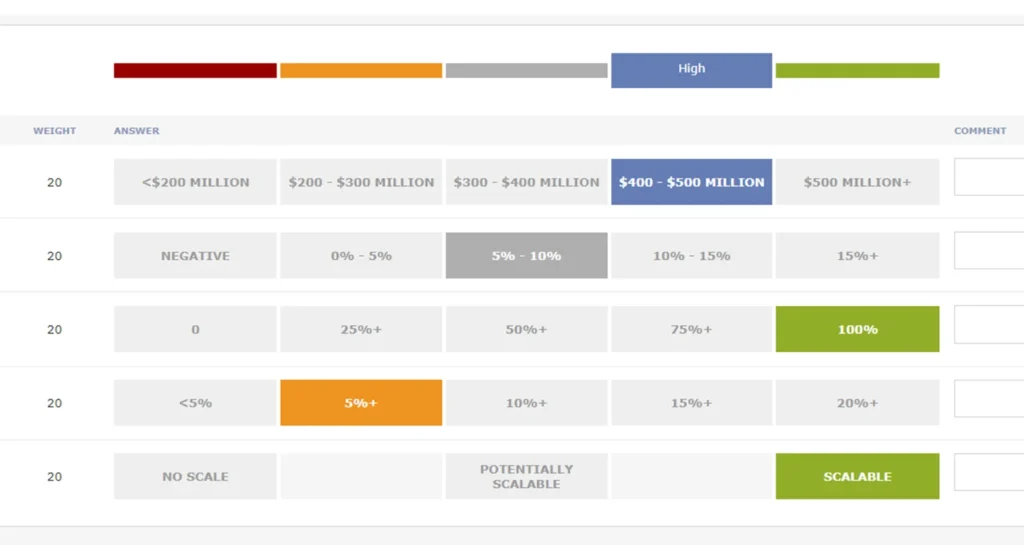
What is it? A configurable scorecard that evaluates the strategic fit and health of the account relationship — measuring growth potential, relationship strength, strategic alignment, and execution quality.
Why do we do this?
- Provides a leading indicator of account health before accounts are at risk
- Informs strategic account selection and deselection
Example KPIs:
- Positive or negative movement reviewed every six months
- Low-score outliers placed on a probationary period until the next Account Review
Customer SWOT
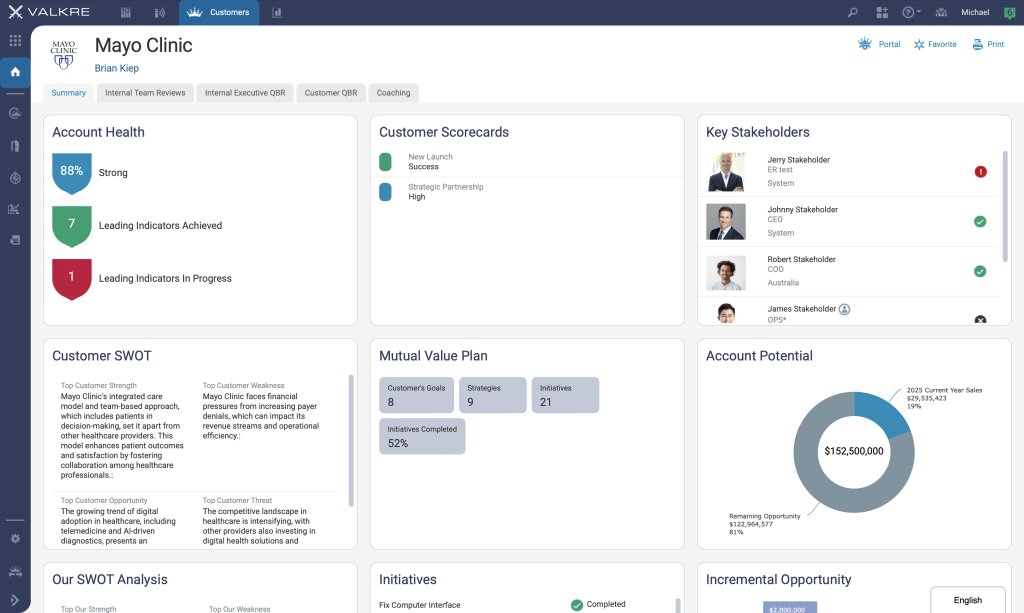
What is it? A structured framework for capturing the customer’s own Strengths, Weaknesses, Opportunities, and Threats from their perspective — distinct from your Internal SWOT.
Why do we do this?
- Educates the account team on the customer’s world and how they compete
- Informs account plan strategies and initiatives
Example KPIs:
- Completed matrix
- Updated within the last year
Customer Organization
What is it? Maps the physical and organizational structure of each account — including locations, sites, buying centers, and org chart relationships.
Why do we do this?
- Provides context on how the customer is organized
- Identifies the right entry points and buying centers for strategic engagement
Example KPIs:
- Organization completeness and regular updates
2. Analyze
Customer-side analysis only tells half the story. The Internal SWOT is where the team assesses its own position honestly — before it commits to a plan built on assumptions rather than facts.
Internal SWOT
What is it? A structured framework for your team to assess your organization’s own Strengths, Weaknesses, Opportunities, and Threats in relation to this specific account.
Why do we do this?
- Grounds account strategy in honest internal assessment rather than assumptions
- Identifies gaps to address and strengths to leverage in the account plan
Example KPIs:
- Completed matrix
- Updated within the last year
3. Plan
Beginner-level planning centers on Mutual Objectives — what you and the customer agree to pursue together. At the intermediate level, you add a second lens: what your organization specifically expects to gain.
Our Expected Value
What is it? Documents the value your organization expects to receive from this account — revenue targets, growth opportunities, and strategic benefits — creating alignment between the account plan and internal business objectives.
Why do we do this?
- Aligns the account team around shared internal targets
- Creates a clear connection between account effort and business outcome
Example KPIs:
- Expected value documented and linked to mutual objectives
- Reviewed and updated at each Account Review
4. Align
As programs mature, more people touch the account than the core team alone. These tools make that broader activity visible and reviewable.
Initiative Timeline
What is it? A visual, chronological view of all initiatives and key milestones across the account. Provides leadership and the broader team with a clear picture of what’s happening and when.
Why do we do this?
- Gives stakeholders a clear, visual view of execution progress
- Identifies sequencing conflicts or resource constraints across initiatives
Example KPIs:
- All active initiatives represented on the timeline
- Reviewed at each internal Account Review
Interactions
What is it? Tracks all meaningful touchpoints between your team and the customer — beyond formal meetings. Provides a comprehensive picture of engagement breadth, frequency, and quality.
Why do we do this?
- Builds a complete record of relationship activity across all team members
- Identifies gaps in coverage or over-reliance on a single relationship
Example KPIs:
- Number of unique team members with logged interactions
- Interaction frequency reviewed quarterly
5. Execute
Beginner-level execution is about getting things done. Intermediate execution adds two disciplines that beginner teams rarely have bandwidth for: naming what’s blocking progress, and coaching the team’s behavior against it.
Barriers
What is it? Documents obstacles that are blocking progress on initiatives, objectives, or the broader account relationship — with owners and resolution plans assigned.
Why do we do this?
- Surfaces blockers before they derail execution
- Creates shared accountability for removing obstacles
Example KPIs:
- No unassigned barriers
- All barriers have a resolution owner and target date
Coaching Scorecard
What is it? A configurable scorecard used by managers to evaluate account team performance against key behaviors, process adherence, and program expectations.
Why do we do this?
- Provides managers with a structured tool to coach account teams
- Creates consistency in how program expectations are communicated and measured
Example KPIs:
- Scorecard completion rate by manager
- Coaching cadence of at least once per quarter
6. Measure
This is where an intermediate program earns its name. Beginner-level dashboards tell you what happened. These tools tell you what’s about to happen — before revenue confirms or denies it.
Achievements
What is it? Defines the specific behaviors and milestones that indicate a healthy, high-performing account relationship — and tracks them automatically on a daily basis. Provides leading indicators of account success before revenue impact is felt.
Why do we do this?
- Shifts focus from lagging revenue metrics to leading behavioral indicators
- Creates objective, consistent criteria for account health across the portfolio
Example KPIs:
- Achievement completion rate across the portfolio
- Percentage of accounts with green achievement status
Customer Scorecard
What is it? Configurable relationship scorecards that provide leading indicators of account health. Achievements can be set based on Scorecard Types and Dates to establish governance on update frequency.
Why do we do this?
- Quantifies relationship health in a consistent, comparable way
- Creates a shared language for account health across the program
Example KPIs:
- Scorecard completion rate
- Positive score movement across the portfolio, reviewed semi-annually

From Compliance to Insight
The beginner toolkit is fundamentally about getting a program running and keeping it honest. The intermediate toolkit is about something different: turning the discipline of running a program into a source of insight the rest of the business can act on. A FIT Scorecard that flags a declining account six months before renewal. A Coaching Scorecard that turns manager reviews into a repeatable process instead of a gut check. That’s the shift Level 2 is really about.
Where These Tools Live Starts to Matter
A FIT Scorecard filled out once a quarter in a shared document is a compliance exercise — useful, but static the moment it’s saved. The same scorecard, live inside a system the whole cross-functional team can see and update in real time, becomes something different: an early warning that reaches the right people while there’s still time to act on it. The same is true for tools like Our Expected Value or a Customer SWOT. The value isn’t in filling them out. It’s in everyone touching the account working from one single version of the truth instead of multiple conflicting copies scattered across inboxes and shared drives.
This is the point in a program’s maturity where the technology underneath the framework starts to matter as much as the framework itself. Platforms like Valkre are built around exactly this problem — turning the tools above from a set of documents someone has to remember to update into a living account plan that stays current because the team is already working in it.
Partner Perspectives
In this section, we link to content from our partners in the strategic account management community. Please note some content may require a paid membership.
LEARN MORE
For a real-world look at what this shift looks like at scale, read From Vision to Impact in SAMA’s Velocity magazine (Vol. 27, Issue 3, 2025). Written by Frankie Cusimano of UL Solutions — a Valkre customer — the article details how UL Solutions built its Account Management program from the ground up in under five years, replacing static, scattered account plans with a real-time platform, and won the 2025 SAMA Excellence Award for Outstanding Young Program of the Year for it.
Put It to Work
To test if your team has outgrown the beginner toolkit, start with these questions:
- Where is your team already exceeding the beginner baseline without formally recognizing it?
- Which of your accounts would benefit most from a FIT Scorecard or a Customer SWOT right now?
- What would it take to make account health a leading indicator your team acts on — instead of a trailing one you report on?
Start with the accounts where the answers are clearest. Pilot one or two intermediate tools with a cross-functional team before rolling them out across the portfolio, and give the team time to build the habit before adding the next layer. Aim for proficiency at the intermediate level for six to twelve months before moving to an advanced approach, which we’ll cover in our next post.
Conclusion
Designing an intermediate-level KAM program is about resolution, not reinvention. You’re not replacing the beginner framework — you’re sharpening it, splitting analysis from planning, and giving the team the tools to see problems before they show up in the numbers. Done well, this is the stage where a KAM program stops being a set of good habits and starts being a genuine source of competitive advantage.