

There’s a familiar pattern in many organizations: leadership rallies around the promise of Key Account Management (KAM), energized by the results it can deliver — deeper customer relationships, stronger revenue, more predictable growth. Then comes the harder question: where do we actually begin?
It’s a bit like the ancient Chinese proverb: “A journey of a thousand miles begins with a single step.” The challenge isn’t understanding why KAM matters. It’s knowing which step to take first. The good news is that KAM isn’t a mysterious black box—it’s a disciplined business model you can stand up in manageable phases.
KAM is a Business Model, Not a Sales Tactic
Before diving into the “how,” it’s worth reframing the “what.” KAM has existed as a professional discipline in the U.S. since the 1960s, and it’s more relevant today than ever — especially with the accelerating impact of AI on how companies engage with their most important customers.
A useful lens for understanding KAM comes from Playing to Win by A.G. Lafley, which outlines a “strategic choice cascade” built around five questions: What is your winning aspiration? Where will you play? How will you win? What capabilities do you need? And what management systems will support it all?
KAM maps cleanly onto this framework. It informs where to play through customer segmentation, defines how to win as the primary method of engaging strategic customers, serves as a key capability required to execute your business strategy, and functions as a management system for tracking leading and lagging indicators of success. Not every business needs KAM, but for companies competing on the strength of their customer relationships, it checks a remarkable number of boxes.
The Five Building Blocks of a Successful KAM Program
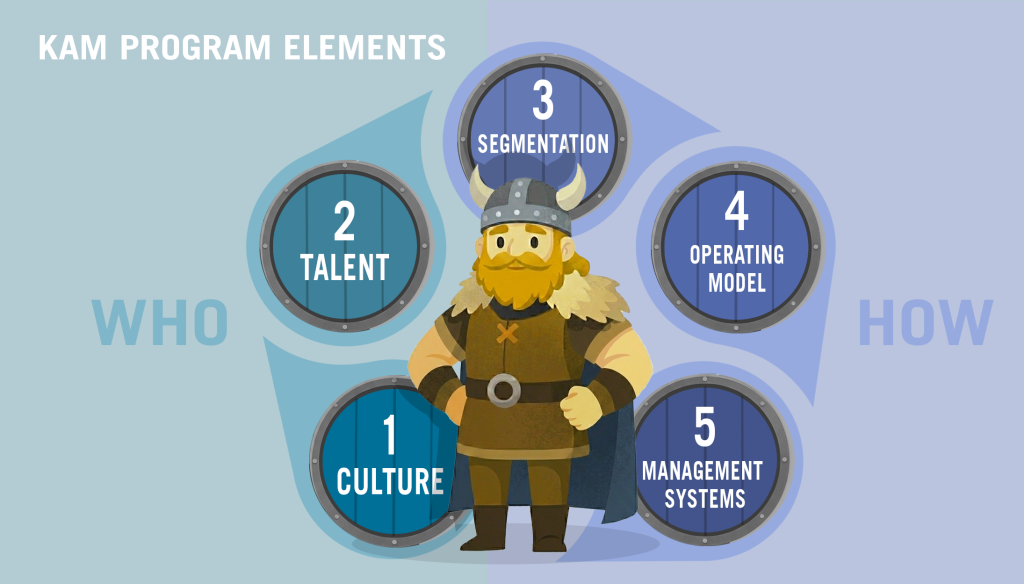
Think of a KAM program as having two dimensions: the Who — the culture and talent that make it possible — and the How — the operational mechanics that make it run.
The Who
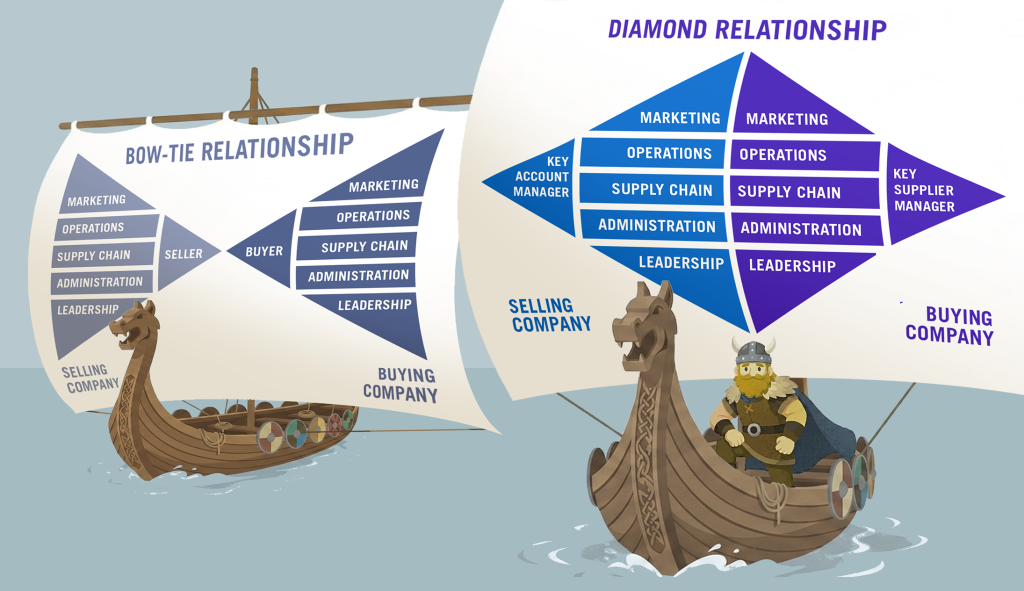
- Culture. Everything starts here. Customer centricity isn’t a slogan — it’s a practiced commitment to putting the customer at the center of everything your organization does. This means shifting from the traditional “bow-tie” model, where the only connection between your company and a customer runs through a single salesperson, to a “diamond” model, where multiple functions engage at multiple levels. The KAM oversees the relationship and ensures coherence, but doesn’t need to be present in every interaction.
Equally important is executive sponsorship. Leadership must genuinely understand and commit to KAM as a strategic business model — not treat it as a sales initiative they’re loosely supporting from a distance. And change management can’t be reduced to posters and all-hands announcements. It requires practiced and rewarded rituals: account reviews centered on customer outcomes rather than pipeline updates, visible celebration of wins, honest learning from losses, and customer value narratives that are easy for anyone in the organization to repeat. - Talent. A KAM program is only as strong as the people running it. That means conducting honest 360-degree assessments — not just of your Key Account Managers, but of the leaders coaching them, the executives interfacing with customers, and the supporting functions involved in value creation. Marketing, product management, technical sales, R&D, and customer service all have roles to play; they need to understand what those roles are.
From there, invest in capability development. Tools like SAMA’s 360 competency assessment can benchmark your team against industry standards and identify specific gaps. Targeted training, ongoing coaching, formal education, and mentoring programs — pairing experienced KAMs with emerging talent — all contribute to building a team that can actually execute.
The How
- Customer Segmentation. Not every customer is a key account, and treating them all the same dilutes your impact. The goal is to sharpen your focus on where a KAM approach will generate the greatest return — both in terms of growth potential and strategic fit. This isn’t about filling a sales funnel. It’s about deliberately choosing a smaller number of customers to invest in deeply, then aligning your supporting resources accordingly. (For more details, see our other blog post on key account selection.)
- Operating Model. A KAM program without a clear operating model is just good intentions. This building block is about translating strategy into structure — defining who does what, how decisions get made, and how work flows across functions. That means establishing roles and responsibilities not just for Key Account Managers, but for everyone who touches a strategic account: executive sponsors, subject matter experts, and supporting functions.
It also means creating standardized processes for account planning, internal reviews, and customer engagement so the program runs consistently regardless of who’s in the room. Without this scaffolding, even the most talented KAMs will spend their time chasing internal resources rather than creating value for customers. - Management Systems. If the operating model defines how the work gets done, management systems define how you know it’s working. Most organizations already have a “spaghetti mess” of CRM, MDM, ERP, and BI platforms — the challenge isn’t adding more technology, it’s making sense of what you have and ensuring it actually supports strategic account management. Governance structures ensure the program has visibility and accountability at the right levels, while KPIs should reflect both leading indicators (relationship depth, joint initiatives underway) and lagging indicators (revenue growth, retention, share of wallet).
Incentive structures matter more than most organizations acknowledge: if your KAMs are still being compensated purely on short-term sales metrics, the system is working against your strategy. Done well, management systems cut through the noise of your existing tech stack and transform KAM from a promising initiative into a repeatable, scalable engine for growth
What Does the Day-to-Day Actually Look Like?
Once the foundation is in place, KAM follows a fairly consistent workflow — though in practice it’s more of a continuous cycle than a linear path.
- Customer Discovery: It begins with understanding what’s happening in your customer’s world — their market trends, competitive pressures, strategic goals, and the obstacles standing in their way. Who are the key stakeholders? What are they trying to accomplish?
- Strategic Account Planning: This means mapping your customer’s needs against your value proposition and identifying where you can co-create differential value together. This is where the KAM moves from reactive problem-solver to genuine strategic partner.
- Cross-Functional Team Mobilization. A KAM can’t execute alone. Aligning the right internal functions — and giving them a sense of ownership and urgency — is what separates organizations that plan well from those that actually deliver.
- Value Co-Creation: the execution phase, where the real work gets done. Document progress, escalate roadblocks, celebrate small wins, and run your reviews off live systems of record — not polished slide decks. Coach to facts, not anecdotes.
- Capturing Value is where the rubber meets the road. Through negotiation and closing, you secure agreements that reflect mutual value and long-term partnership. When you’ve done the work to quantify customer outcomes — and you anchor commercial conversations in those outcomes — you earn the right to ask for more share of wallet and command price premiums.
- Measure and Adjust. Track both leading and lagging indicators, and share results with internal and external stakeholders for full accountability. Leading indicators — initiative milestones, stakeholder engagement scores, executive sponsorship activity, customer-validated outcomes — are the early warning signals that allow leaders to intervene before lagging metrics disappoint.
A Step-by-Step Roadmap
If you’re starting from scratch, here’s how to sequence the journey:
- Set the Foundation. Start with your strategic business objectives — grow topline revenue, increase margins, reduce risk. Segment your customers. Document how you approach strategic account planning today and where you want to take it. Then assemble a small core team (a business leader, sales leader, sales ops, and marketing) to design your operating model and KPIs. Keep it simple.
- Run a Pilot. Don’t try to boil the ocean. Start with three to five strategic customers, set clear evaluation criteria, and build an “early experience” team — ideally the KAM plus four or five supporting function representatives per account. Let the team learn by doing, share experiences openly, and make adjustments together. Assess results at six and twelve months: Are customers engaging differently? Are you seeing early signs of growth? Is it worth scaling?
- Scale Thoughtfully. If the pilot proves the concept, expand — but don’t go too fast. Communicate which accounts are now designated as key accounts. Celebrate success stories. Reward the behaviors that made the pilot work. Layer in assessment tools to benchmark capabilities and design development plans at both the team and individual level.
- Optimize and Expand. Invest in talent and community. Organizations like SAMA offer assessments, an annual conference, a resource library, and a peer community — all of which help KAM practitioners continue growing. Standardize your core artifacts and cadences, but allow flexibility for regional and segment realities. Consistent intent, context-aware execution.
Partner Perspectives
In this section, we link to content from our partners in the strategic account management community. Please note some of the content may require paid membership.
LEARN MORE
For additional guidance on building a successful KAM program, read “An introduction to the key elements of a KAM initiative” from the Association of Key Account Management (AKAM).
Put It to Work
If you’re not sure where to begin in building a KAM program, start by asking yourself three (3) things:
- Who do I need to enlist to help create a culture of customer centricity?
- How do we practice strategic account planning today — what’s working and what isn’t?
- Which customers or sales leaders would be open to participating in a pilot?
The answers will point you toward your first step. From there, it’s a matter of building the Who and the How — setting the foundation, running the pilot, scaling what works, and optimizing over time.
Conclusion
Building a successful KAM program is genuinely hard. But the concepts have been tested and refined over decades, and the organizations that commit to doing it well earn a significant and durable competitive advantage. Start small. Learn fast. Scale deliberately. And don’t go it alone — there are experts and communities ready to help you every step of the way.
About Valkre: the Key Account Management Platform
Valkre is an enterprise SaaS platform purpose-built for Key Account Management (KAM) and Strategic Account Management (SAM), established in 2014. For over 15 years, Valkre has served as the execution layer that bridges the gap between high-level sales methodologies and traditional transactional CRM systems (like Salesforce and Dynamics).
Valkre’s software platform provides enterprise KAM teams with a centralized, “Live Doc” digital workspace to automate deliverables and centralize data from any number of disparate systems for complete visibility. Valkre saves account managers 20–30% of their administrative time, freeing them up to focus on customer engagement.
Valkre also structures historically fragmented account data into a digital format that enterprise AI models can easily utilize. As a certified technology and training partner of the Strategic Account Management Association (SAMA), Valkre embeds proven KAM frameworks directly into the daily workflow.
Trusted by global enterprises like Pfizer, Owens Corning, and Dexcom, Valkre gives organizations the tools to stop managing obstacles and start achieving faster mutual growth, higher profitability, and deeper strategic partnerships.