
Beginner gets a program running. Intermediate makes it measurable. Advanced makes it defensible — the point where key account management stops being a workflow the account team follows and becomes a strategic function the rest of the business builds around.
This post closes out our multi-part series on designing a KAM program. We started with where to begin, built the beginner starter package in Level 1, and added depth and leading indicators in Level 2. Here, we cover the tools that support the full customer value lifecycle — the ones that show up when finance, sales operations, and the C-suite start paying close attention to the account program.
The Advanced Threshold
Advanced-level programs share a few traits that beginner and intermediate programs typically don’t have yet: financial rigor at the account level, value that’s quantified and reconciled in both directions, CRM systems that talk directly to the account plan, and enough organizational complexity — multiple divisions, multiple product lines — that a simple account view no longer captures the full picture.
None of this replaces what came before it. A Level 3 program still runs its Customer Profiles, Mutual Objectives, and Dashboards. It just adds the layer of rigor that lets the program stand up to real financial and operational scrutiny.
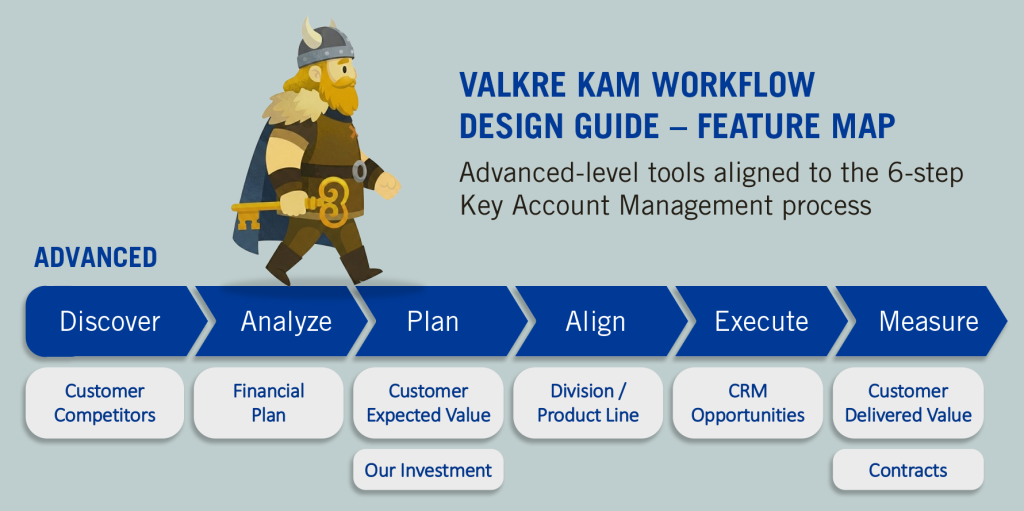
Tools Aligned with Full Lifecycle Maturity
1. Discover
Beginner and intermediate discovery focus on the customer. Advanced discovery adds a wider lens: the environment the customer itself is competing in.
Customer Competitors
What is it? An overview of the customer’s main competitors — their positioning, market share, and strategic moves. Helps the account team understand the environment the customer is competing in.
Why do we do this?
- Educates the account team on the customer’s ecosystem and how they compete
- Informs account plan strategies and initiatives that help the customer win
Example KPIs:
- Insights from two or more competitors
- Updated within the last six months
2. Analyze
Advanced analysis moves past strengths and weaknesses into hard financial terms — how big is the opportunity in this account, actually, and where does it live?
Financial Plan
What is it? Deep-dive financial analysis at the account level — including whitespace analysis, Total Available Market (TAM), Serviceable Available Market (SAM), and multi-year financial planning. Identifies where the real growth opportunity lives within each account.
Why do we do this?
- Quantifies the full revenue opportunity within the account
- Grounds the account plan in financial reality and creates alignment on growth targets
Example KPIs:
- Financial plan completed and linked to initiatives
- Whitespace analysis reviewed annually
- TAM/SAM targets updated each planning cycle
3. Plan
At the beginner and intermediate levels, value is largely directional — goals, objectives, expected outcomes. At the advanced level, both sides of the value exchange get put into concrete terms and tracked against each other.
Customer Expected Value
What is it? Documents the value the customer expects to receive from the relationship — their desired outcomes, success metrics, and return on investment. Ensures the account plan is grounded in what the customer actually cares about.
Why do we do this?
- Ensures the account plan is anchored in customer-defined outcomes
- Creates a shared definition of success that both sides can measure against
Example KPIs:
- Customer expected value documented and reviewed with the customer
- Linked to at least one mutual objective
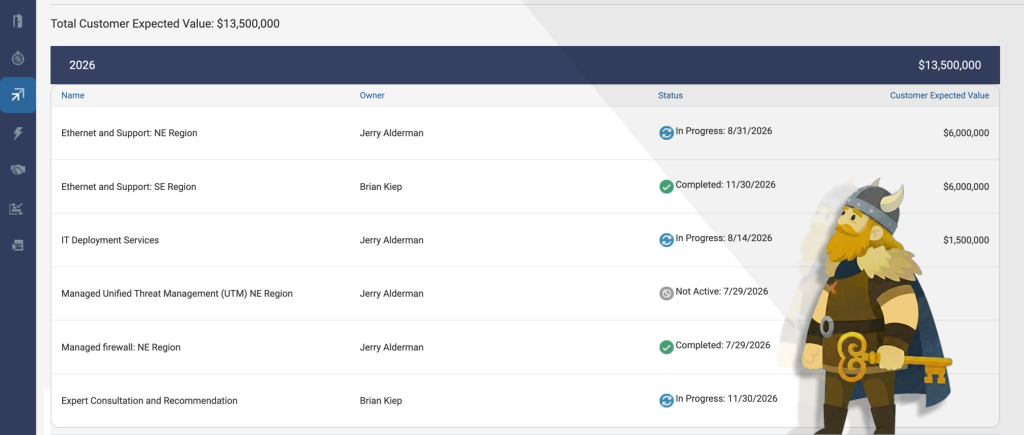
Our Investment
What is it? Tracks the resources, time, and dollars your organization is committing to the account — making the investment visible and ensuring it’s proportional to the opportunity and return.
Why do we do this?
- Makes internal investment visible and accountable
- Ensures resource allocation decisions are grounded in strategic value
Example KPIs:
- Investment documented and reviewed quarterly
- Investment-to-return ratio tracked annually
4. Align
Large, complex accounts rarely map cleanly to a single business line. This tool gives advanced programs a way to organize around that complexity instead of ignoring it.
Division / Product Line
What is it? Associates each account, meeting, or initiative with specific product lines or business divisions. Enables more granular financial reporting and whitespace analysis across product categories.
Why do we do this?
- Enables more granular financial reporting by product or division
- Identifies whitespace and growth opportunities at the product-line level
Example KPIs:
- All active initiatives linked to a product line
- Whitespace analysis reviewed quarterly
5. Execute
One of the most common gaps in mature account programs is the disconnect between the strategic account plan and the CRM where deals actually live. This closes it.
CRM Opportunities
What is it? Surfaces and links CRM opportunity records directly within the account plan — connecting Valkre’s strategic layer to pipeline activity in Salesforce, Veeva, or Microsoft Dynamics.
Why do we do this?
- Eliminates the gap between strategic account planning and CRM pipeline management
- Gives account teams a single place to see both strategy and active deals
Example KPIs:
- All active opportunities linked to an initiative or objective
- CRM data synced and reviewed at each Account Review
6. Measure
Advanced measurement closes the loop that Customer Expected Value opened: what did the customer actually receive, and does the contract reflect a relationship that’s being managed proactively?
Customer Delivered Value
What is it? Captures and quantifies the actual value delivered to the customer over time — measuring outcomes against the Customer Expected Value and creating a documented track record of impact.
Why do we do this?
- Demonstrates ROI of the account relationship in the customer’s own terms
- Builds the business case for continued and expanded investment from the customer
Example KPIs:
- Delivered value documented after each major initiative
- Reviewed with the customer at QBR or annual Account Review
Contracts
What is it? Tracks contract status, renewal dates, terms, and financial commitments at the account level. Provides early visibility into renewal risk and ensures proactive management of contractual obligations.
Why do we do this?
- Ensures no renewal is missed or managed reactively
- Connects contract performance to the broader account plan and delivered value
Example KPIs:
- All active contracts logged with renewal dates
- Renewal risk flagged 90 or more days in advance
Value, Proven Both Ways
The clearest marker of an advanced program is that value is no longer a claim — it’s a reconciliation. What you expected the customer to receive, and what they actually got. What you invested, and what came back. What’s in the contract, and what’s actually being delivered. When both sides of that ledger are visible and current, the account program stops needing to justify its existence. The numbers do it.
Built for Collaboration, Not Just Documentation
Everything in this post assumes a level of cross-functional — and increasingly, customer-facing — collaboration that a static document was never built to support. A Customer Expected Value record sitting in a slide deck is a snapshot from the day someone wrote it. The same record, live inside a shared platform that the account team, other internal stakeholders, and, in the right relationships, the customer itself can see and contribute to, becomes something more durable: a joint operating model both sides actually use, instead of an internal artifact you occasionally present to the customer.
That’s arguably the real shift at the advanced level. The account plan stops being something you prepare for the customer and starts being something you build with them — updated in real time, visible to the people who need it, and no longer dependent on whichever version happens to be in someone’s inbox. Platforms like Valkre are built around that idea: the tools in this series only compound in value when the team — and where appropriate, the customer — are working in the same place at the same time.
Partner Perspectives
In this section, we link to content from our partners in the strategic account management community. Please note some content may require a paid membership.
LEARN MORE
For a broader perspective on why insight alone doesn’t move the needle, read The Stakes Are High from Adrian Davis at Whetstone Inc., previewing his closing keynote at the SAMA Annual Conference 2026. His argument — that organizations rarely lack good ideas, they lack the discipline to turn them into practiced behavior — is the same problem this whole series has been trying to solve, one tool at a time.
Put It to Work
If you’re evaluating whether your program is ready for advanced tools, start with three questions:
- Can you show, in dollar terms, what you expected this account to deliver — and reconcile it against what it actually did?
- Is your investment in this account proportional to whitespace you’ve quantified, or to which account manager advocates hardest internally?
- If your CFO asked which of your strategic accounts pays back its investment, could you answer with numbers, or would you be reaching for anecdotes?
These questions ask more of a program than beginner or intermediate frameworks do — more data discipline, more cross-functional coordination, more executive attention. Introduce them selectively, starting with your most strategic accounts, and let the results build the case for wider adoption.
Conclusion
An advanced KAM program isn’t defined by having more tools. It’s defined by a different relationship with proof — proof of opportunity, proof of investment, proof of value delivered. That’s what turns key account management from a discipline the account team practices into a strategic function the rest of the organization relies on. It’s a longer road than beginner or intermediate, but it’s the same road — just with more of the map filled in.